

Skip to Content
Contact
mail
call

Hall cooling and air conditioning of industrial halls

Efficient solutions for stable processes and controlled temperatures


Rising outdoor temperatures, increasing demands for energy efficiency and ever more sensitive production processes are making industrial hall cooling a key technical issue for many industrial companies. Find out what challenges arise when cooling large industrial halls, what systems are available, and what is essential for energy-efficient industrial hall cooling to ensure stable temperatures and processes.


Request consultation

Ideal working conditions

Why cooling in industrial buildings is a key factor in productivity


In industrial production environments, the hall climate directly affects the stability of manufacturing processes, the lifespan of technical systems, and the strain on employees during operations.

Already high internal heat loads from machines, production systems, lighting systems, or continuous process waste heat can lead to uncontrolled heat buildup within the hall.

Companies that opt for modern industrial hall cooling systems not only create better working conditions, but also reduce operating costs, avoid unnecessary peak loads and improve their building’s overall energy performance.


Uniform air conditioning

Technical challenges in cooling large industrial halls

Large halls present special requirements for air conditioning, as classic comfort cooling is often not sufficient. With increasing hall height, temperature gradients develop, where warm air is trapped under the hall roof while individual work areas remain unevenly tempered.


The following are particularly relevant:

• Thermal stratification in large hall volumes

• High sensible heat loads from production processes

• Process-related waste heat from machines and systems

• Uncontrolled airflows within the hall

• High energy demand for classic air conditioning systems

• Different temperature requirements for individual hall areas


An efficient hall cooling system therefore has to remove heat specifically where it is actually generated, while simultaneously ensuring stable temperature conditions in the relevant work area.

Individual Requirements

What factors need to be taken into account when planning a hall cooling system?


Not every industrial hall requires the same form of air conditioning. The requirements vary significantly depending on the production process, operating hours, building structure, and thermal load.

Before planning, the following questions should be clarified:

  • What production or logistics processes take place within the hall?
  • What are the internal heat loads from machines and equipment?
  • Are there temperature-sensitive production processes or sensitive materials?
  • Do individual areas of the hall need to be temperature-controlled independently?
  • Is there shift work, peak loads, or highly variable usage profiles?
  • Is year-round cooling or only seasonal temperature control required?

For a technical design, various building factors must also be considered:

  • Hall size and total room volume
  • Building height and thermal stratification within the hall
  • Insulation standard of the roof and building envelope
  • Solar radiation and building orientation
  • Window areas, skylights, and roof lights
  • Process heat from machines
  • Lighting systems and electrical loads
  • Air exchange rates and existing ventilation technology
  • Regional outdoor temperatures and seasonal load profiles

Tasks

Three central requirements of any industrial hall cooling system

For economical hall cooling, it is not only crucial how cooling capacity is provided. Equally important is how the cold is distributed in the hall and how heat gains can be reduced or avoided even before actual cooling.

Therefore, three central tasks must be considered when planning hall cooling:

1) Distribution of cold: So that cooling capacity works exactly where employees, machines, and processes need it.

2) Generation of cold: To provide the cooling demand efficiently and economically (evaporative cooling, heat pumps, refrigeration systems or hybrid systems)

3) Removal of heat loads and utilization of natural resources: To utilize natural cooling potentials and minimize the need for mechanical cooling (removal of process heat, evaporative cooling, natural cooling potentials such as free cooling with cool outside air or night cooling).


The various hall cooling systems mainly differ in how they address these three requirements. Therefore, the evaluation of a cooling solution should always consider the entire temperature control concept and not just the pure cold generation.


Systems for hall cooling

The most commonly used systems include:

  • Floor cooling systems (underfloor heating)
  • Ceiling cooling systems
  • Evaporative cooling (adiabatic cooling)
  • Classic ventilation cooling
  • Modern integrated cooling systems for industrial applications


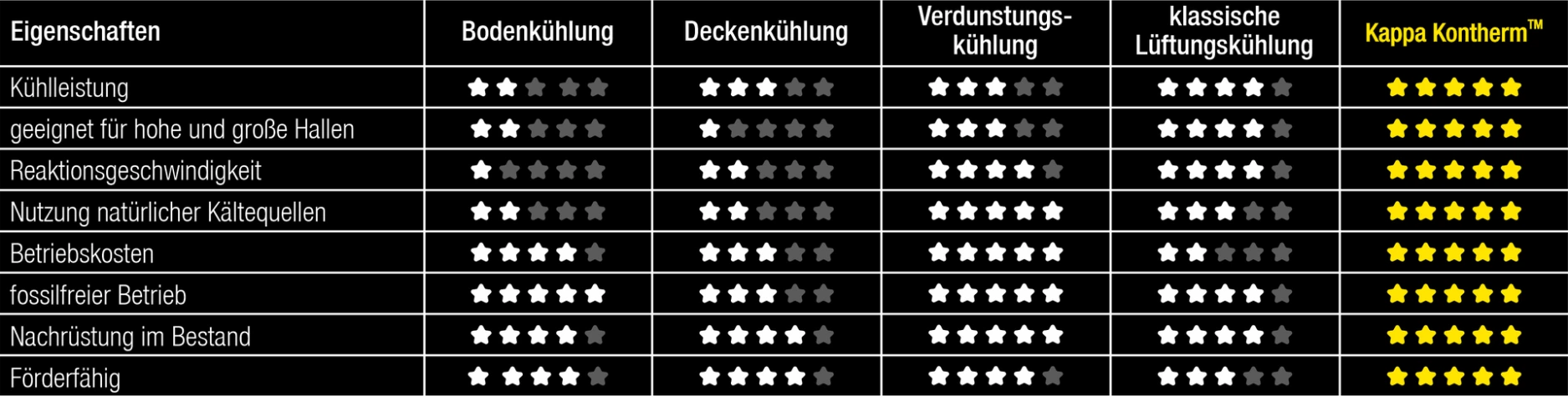
Each of these systems is based on different physical principles and offers specific advantages and disadvantages in terms of energy efficiency, investment costs, temperature distribution, operating costs, and sustainability. The right solution depends on the hall geometry, heat loads, temperature requirements, and the available natural cooling potentials.


The most economical hall cooling is usually not achieved through a single technology, but through the intelligent combination of efficient cold distribution, demand-oriented cold generation, and maximum utilization of natural cooling resources.

System Comparison


Thinking holistically

Modern hall cooling as a comprehensive concept

Hall cooling systems are not only about the type of cold generation. What matters is how effectively the cold is distributed in the usage area, how heat loads are reduced, and to what extent natural cooling potentials can be utilized.


This is exactly where integrated system solutions come into play:

Example of modern hall cooling technology:Kappa KonthermTM

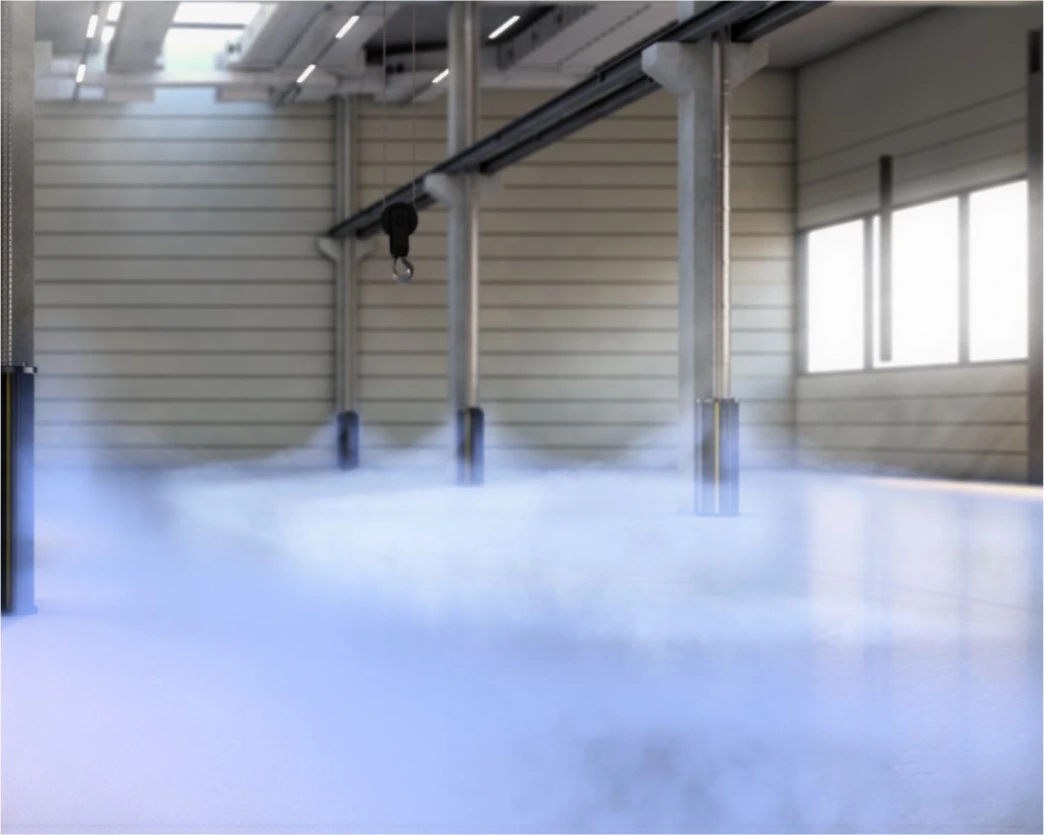
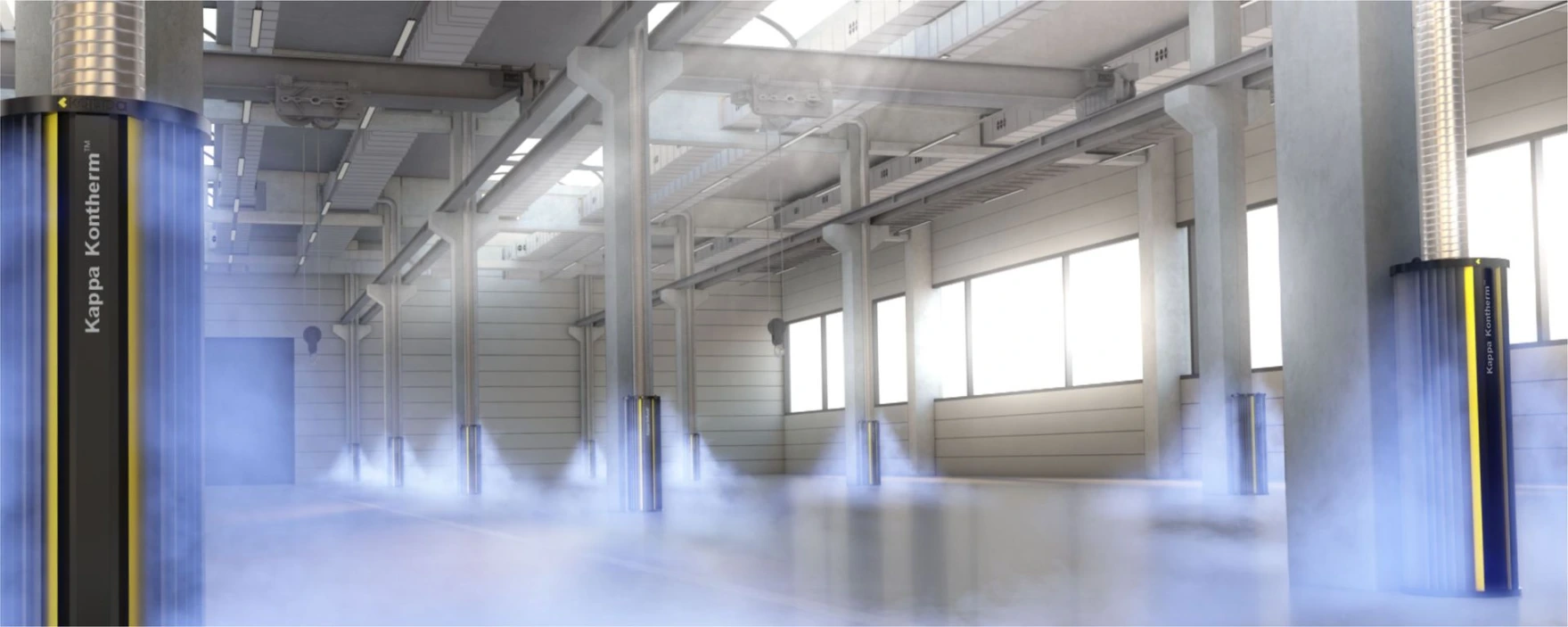
Kappa KonthermTM It was developed specifically for large industrial, production and logistics halls. Unlike conventional cooling systems, the focus is not simply on providing cooling, but on the interplay between efficient cooling distribution, demand-driven cooling generation and intelligent heat load management.

The goal is to remove heat from the building as early as possible, to optimally utilize natural cooling potentials, and to cover the remaining cooling load with minimal energy input. This creates a highly efficient overall system for industrial hall cooling.


Learn more about Kappa Kontherm


Request a free initial consultation

Find out what savings potential lies in your hall.


REQUEST CONSULTATION


Interesting facts

FAQ


High temperatures can disrupt production processes, place additional strain on machinery and worsen working conditions. Controlled hall cooling ensures stable operating conditions and enhances process reliability.

The systems used include, amongst others, air-conditioning systems, evaporative cooling, ventilation systems, heat pumps and integrated heating and cooling systems. The choice depends on the intended use, the size of the hall and the heat loads.

Key factors include hall volume, building height, machine waste heat, solar radiation, air exchange rates, and the total thermal load within the building.

Yes, many systems can also be integrated into existing industrial and storage halls. A technical plan that can be implemented without major renovations is crucial.

Yes, modern indoor climate control systems allow for both heating and cooling within a single integrated system.

Many years of experience

Partner for hall cooling

Kappa Filter Systems has many years of experience in the planning and implementation of hall cooling solutions and hall heating solutions for industrial, production, and logistics halls. The technical support ranges from the renovation of existing halls to the planning of new construction projects to support with regulatory procedures and funding programs. The focus is on energy-efficient solutions that are tailored to the specific hall geometry, usage, and available energy potentials.

Let’s talk about your project

Please share your requirements for hall cooling and goals with us. Our specialists are happy to assist you from the initial consultation to implementation.

Kappa Filter Systems GmbH

AT-4407 Steyr-Gleink, Im Stadtgut A1

0043 7252 21 111

DE-40549 Düsseldorf, Wiesenstraße 21

0049 211 506 6978 0

office@kappa-fs.com

www.kappa-fs.com


*Required fields