ATEX EXHAUST SYSTEMS: FIRE AND EXPLOSION PROTECTION FOR POTENTIALLY EXPLOSIVE ATMOSPHERES (DUST AND GASES)
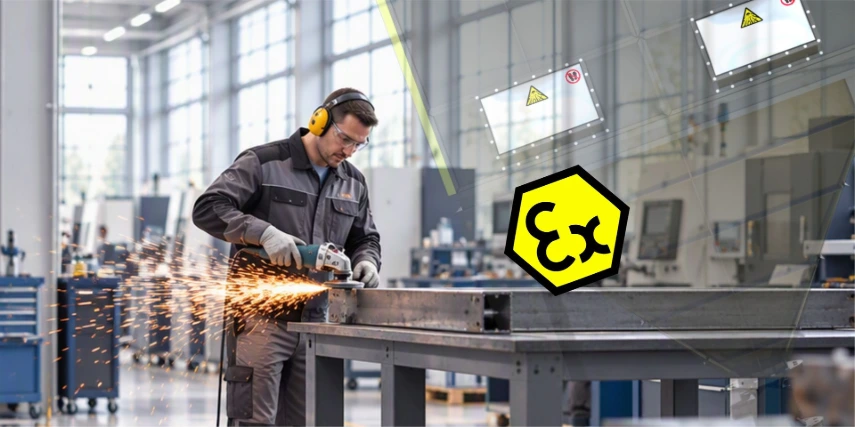
A spark from the grinding process, a cloud of dust during cleaning: that’s all it takes for an explosion in the filter. An ATEX sticker alone does not make an extraction system explosion-proof. Kappa’s in-house ATEX team plans the entire system, from dust analysis right through to commissioning.
# Tailored solutions to meet your needs
# Our own ATEX team, which specialises exclusively in the design and installation of explosion-proof systems
# Project engineers acting as experts in explosion protection in accordance with ÖNORM Z 2200
# Over 30 years’ experience with explosion-proof ventilation systems
Why is an
ATEX-certified device
not sufficient on its own?
An ATEX marking confirms that a piece of equipment has been classified for a specific category. Whether the extraction system is safe in operation also depends on the pipework, decoupling, dust discharge and the properties of your dust.
Often, an ATEX extraction system is chosen as a product: appropriate labeling, connect, done. However, system boundaries remain open. Without decoupling, an explosion in the filter can spread through the piping to connected machines or into the hall. Through clean gas lines, a zone can be transported into areas that are not designed for it. Only explosion characteristics such as minimum ignition energy, lower explosion limit, or ignition temperature show which protective measures are actually effective.
Explosion protection does not stop where standard solutions reach their limits. The ATEX team at Kappa evaluates the entire extraction system, from the point of capture to the dust container.
Individual ATEX extraction system for your processes
Before we design a system, we analyse and assess each client’s processes holistically, incorporate appropriate protective measures and ensure that the documentation is transparent and traceable. This results in a design that is tailored to actual operational conditions. The system is then neither under-specified nor overburdened with unnecessary measures. The aim is to deliver a solution that is safe and also offers good value for money for the client.
Key questions for a holistic approach include:
- What dusts or gases are generated?
- in what quantities?
- at what temperatures?
- and at which points in the system?
It is only from this data that it becomes clear where explosive atmospheres may occur and which protective measures are effective in such locations.
ATEX experts
at Kappa
As a supplier of ATEX systems, explosion protection at Kappa is managed by a dedicated team and is an integral part of the quality management system.
- A dedicated ATEX team is solely responsible for the design and implementation of ATEX systems.
- Trained installation and service engineers – take care of the ongoing maintenance of your ATEX extraction system.
- The experts in the team act as qualified persons for explosion protection in accordance with ÖNORM Z 2200.
- Die Ex-Prozesse für Planung, Konstruktion, Ausführung, Installation und Wartung sind im Kappa-Qualitätsmanagementsystem festgelegt.
- Since the ATEX Directive came into force, Kappa has been actively involved in the standardisation committee of the ASI – Austrian Standard Institute.
- Kappa has installed ATEX systems in a range of industries.
Services for fire- and explosion-protected installations
- Risk analysis and protection concept: Assessment of explosion hazards and ignition sources; definition of protective measures
- Customised explosion protection for complex industrial plants and bespoke solutions for technical constraints
- Conformity assessment of complete systems, including manufacturer’s responsibility and technical documentation
- Verification in collaboration with testing organisations, experts and, where applicable, notified bodies
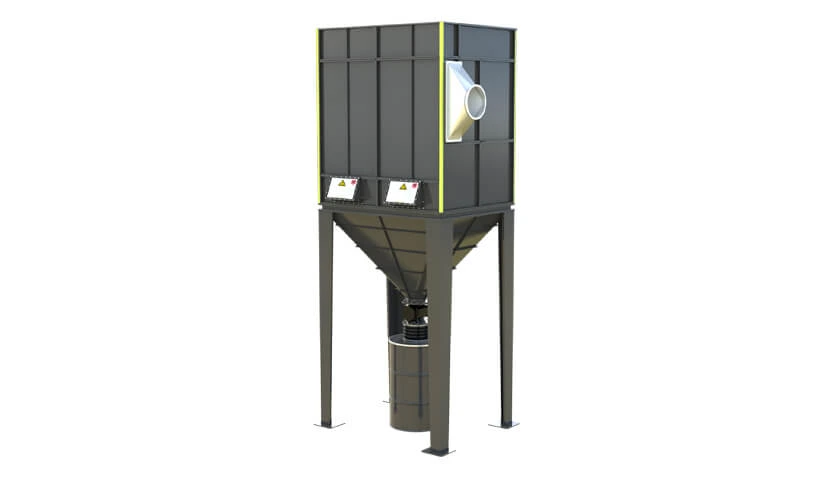
The ATEX filter system: Kappa IPR-ATEX dust collector
In the modular Kappa IPR-ATEX dust collector, an integrated pre-separator (Integrated Separator Panel) separates coarse dust, sparks and incandescent particles before they reach the filter elements. This ensures that fewer potential ignition sources enter the filter chamber. Fine dust is collected on the surface of the filter elements and automatically removed by a compressed air pulse.
Depending on the safety concept, the range extends from anti-static and ignition-source-free designs to variants with explosion suppression. The dust extractor is designed for fine dust, coarse dust and hybrid mixtures. At the workplace, extraction booths, extraction tables and extraction arms complement the extraction system.
Let's talk about your project
Share your requirements and goals with us. Our specialists are happy to support you from the initial consultation to implementation.
Kappa Filter Systems GmbH
AT-4407 Steyr-Gleink, Im Stadtgut A1
0043 7252 21 111
DE-40549 Düsseldorf, Wiesenstraße 21
0049 211 506 6978 0
office@kappa-fs.com
www.kappa-fs.com
Interesting Facts
FAQ
ATEX stands for Atmosphères Explosibles and refers to two EU directives:
- The Operator Directive 1999/92/EC requires employers to assess explosion hazards, define zones, and create an explosion protection document.
- The Product Directive 2014/34/EU regulates how equipment and protective systems for explosive atmospheres are designed, assessed, and marked.
In Austria, the Operator Directive is implemented in the regulation on explosive atmospheres (VEXAT), in Germany in the Operational Safety Regulation and the Hazardous Substances Regulation.
There is no single set of regulations for fire protection of extraction systems. The requirements arise from building law (in Austria, the OIB guidelines; in Germany, the ventilation system guidelines of the states), from standards for fire dampers, from employee protection, from the approval notice of the operating facility, and often from the specifications of the insurer, for example regarding spark detection and extinguishing. Many of these rules are written for building ventilation. Standard solutions do not always fit when dealing with dust-laden process air. Therefore, the ATEX team at Kappa defines fire and explosion protection collaboratively and facility-specifically, coordinated with fire protection officers, authorities, and insurers.
The following dusts are combustible:
- Wood and paper: wood dust, sanding dust, cellulose
- Food and agriculture: flour, sugar, starch, milk powder, cocoa, grains, animal feed
- Plastics: PE, PP, PVC, powder coatings, toner
- Chemicals and pharmaceuticals: many active ingredients, dyes, sulfur
- Metals: aluminum, magnesium, titanium, zinc, iron dust. Metal dusts are often particularly intense (St3).
- Coal and fuels: coal dust, soot, biomass
An extraction system poses an explosion risk as soon as it carries flammable dust in an explosive concentration and an effective ignition source is present. This concentration is more frequently reached in the filter than in the workshop. Every time the filter is cleaned, a dense cloud of dust forms briefly in the raw gas chamber.
In operation, this manifests at specific points. Grinding processes carry sparks into the piping. With too low flow velocity, dust settles in the duct. After a product change, particle size and ignition sensitivity change. And during maintenance or filter changes, maintenance works on a part of the system where Zone 20 may prevail.
- Zone 20: explosive dust atmosphere present continuously, for long periods or frequently; Equipment Category 1D
- Zone 21: explosive dust atmosphere occasionally present during normal operation; equipment category 1D or 2D
- Zone 22: explosive dust atmospheres are not normally present, or are present only for short periods; equipment category 1D, 2D or 3D
Dust explosion classes describe how violently a dust explodes, i.e. how quickly the pressure rises during an explosion. The following dust classes exist:
| Class | Kst (bar·m/s) | Violence | Examples |
|---|---|---|---|
| St 0 | 0 | not explosive | Sand, cement |
| St 1 | > 0 to 200 | weak to medium | Wood, sugar, grain |
| St 2 | 200 to 300 | strong | some plastics, starch, pigments |
| St 3 | > 300 | very strong | fine aluminum, magnesium |
Usually, sparks or glowing particles from the process enter the filter through the piping, for example when grinding, cutting, or welding. There, they ignite accumulated dust or the filter medium. Other causes include self-heating of certain dusts, hot surfaces, friction in the fan or discharge organ, as well as electrostatic discharges. Dust deposits in piping and filters, as well as oil or emulsion components in the dust, increase the risk. A pre-separator like in the Kappa IPR-ATEX dust collector separates sparks and glowing particles before they reach the filter elements.
A fire in the extraction system is more common than an explosion and often its trigger. Sparks from grinding or cutting processes ignite accumulated dust in the filter, creating smoldering spots. If smoldering dust is stirred up during cleaning, an ignition source can meet an explosive dust cloud. Therefore, the ATEX team at Kappa Fire and Explosion Protection plans together: Sparks are detected or separated before they reach the filter, and smoldering spots are identified before they become an ignition source.
- Primary: Design the collection system, air flow path and flow velocity in such a way that dust does not settle or accumulate in pipework and system components as far as possible.
- Secondary: Avoid sources of ignition, for example by using spark arrestors upstream of the filter, anti-static filter media, earthing and equipotential bonding, as well as fans and discharge devices that do not produce sparks.
- Tertiary: Minimise the impact, for example through pressure relief, explosion suppression and decoupling of the pipework.
Das Explosionsschutzdokument verantwortet der Betreiber; es muss vor dem ersten Betrieb vorliegen, auch vor einem Probebetrieb. Der Anlagenhersteller baut darauf mit eigener Risikoanalyse und Konformitätsnachweis auf.
Yes. A fire or smoldering spot in the filter is one of the most common ignition sources for a dust explosion. As long as the dust is settled, it often smolders unnoticed. If it is stirred up during compressed air cleaning, during the startup of the system, or when opening the filter, the embers can meet an explosive dust cloud. Therefore, the ATEX team at Kappa Fire and Explosion Protection plans together: Ignition sources should not even enter the filter, and the effects of an event are limited.
A dust explosion occurs when combustible dust is finely dispersed in the air and meets an effective ignition source. Six conditions must be met for this to happen:
- Combustible dust: organic or oxidizable metal.
- Fineness: Critical particles are those under about 500 µm, particularly dangerous under about 63 µm. The finer, the more reactive.
- Concentration within the explosion limits: The lower explosion limit for many dusts is roughly between 15 and 60 g/m³. This corresponds to a dust cloud in which one can hardly see their hand in front of their face.
- Oxygen
- Effective ignition source: e.g. sparks, hot surfaces, electrostatic discharge, or glowing embers.
- Suspension or distribution in the air
Fire protection prevents dust or filter media from catching fire and limits a fire if it does occur. Explosion protection addresses the rapid combustion of suspended dust with a quick increase in pressure. Both areas overlap: a fire can trigger an explosion, and measures such as spark separation or grounding work against both. The ATEX directives apply for explosion protection, while fire protection additionally involves building regulations and often requirements from insurers. Therefore, an effective protection concept considers both together.
Explosion protection is required when the extraction system handles combustible dusts that can form an explosive atmosphere with air. Typical examples include organic dusts such as wood, flour, or plastic dust, metallic dusts like aluminum, as well as paint and spray dusts. Whether a dust is explosive can be shown by substance databases such as GESTIS-STAUB-EX or a laboratory analysis. The classification is part of the operator's risk assessment.
This depends on dust concentration and cleaning. If the raw gas area is permanently explosion-prone or if cleaning occurs predominantly, it is often classified as Zone 20; if cleaning occurs only occasionally, it is classified as Zone 21. The clean gas area is usually not assigned to any zone as long as no zone migration is expected; otherwise, it is Zone 22. The binding classification is done project-specifically in the risk assessment.
The ATEX filter system is the separator in which dust is separated from the air, such as a dust collector with filter elements. The ATEX extraction system encompasses the entire system: collection point, piping, filter system, fan, dust discharge, and all protective systems such as decoupling or pressure relief. For explosion protection, the system is crucial because zones and explosions can spread across plant boundaries.
This depends on the condition of the system, the material data, and the zone classification. Possible measures include decoupling devices in the piping, pressure relief, antistatic filter media, or a pre-separator for sparks. If the system is not suitable for this, a replacement may be more economical. The ATEX team evaluates the existing system and compares both options.
Data collection and planning usually run parallel to operations. A shutdown primarily affects the installation and integration into existing piping. Its duration depends on the scope of the system and accessibility and is predetermined in the protection concept so that you can coordinate it with your production planning.
The explosion protection document is created by the operator, and he remains responsible for it. The ATEX team from Kappa assists with the zoning of operations and facilities and provides the documentation for the extraction system: risk analysis, intended use, equipment categories, and labeling. This allows the document to be updated for the new or modified facility.
There is no flat rate. The costs primarily depend on the air volume flow, type of dust and explosion characteristics, the zone, and the necessary protective measures. A system with pressure relief to the outside is constructed differently than one with explosion suppression inside the building. In the ATEX consultation, the team clarifies what measures your system needs. This results in a reliable cost framework.
The ATEX team plans according to the hierarchy of explosion protection:
- Firstly, measures are taken to prevent an explosive atmosphere from forming.
- This ensures that potential ignition sources are avoided.
- Finally, the effects of a potential explosion are limited to a manageable level.