Extraction of coolant mist: a single machine, a centralised system or the entire hall?
The appropriate oil mist and emulsion mist extraction depends on three questions: How many emission sources are there? Do vapors and diffuse emissions play a role? And what should happen to the waste heat? In most machining halls, a combination of source extraction and room air technology is the most economical solution.
The hierarchy of protective measures
Die Gefährdungsbeurteilung gibt die Reihenfolge vor: Substitution (z. B. Minimalmengenschmierung) vor technischen, organisatorischen und persönlichen Maßnahmen. Da sich Kühlschmierstoffe in der Praxis selten ganz ersetzen lassen, ist Lufttechnik in der Zerspanung meist unumgänglich. Organisatorisches wie abgedeckte Spänebehälter oder geschlossene KSS-Kreisläufe reduziert die Emissionen zusätzlich.
Option 1: Extraction at the individual machine
Enclosed machining centers are extracted directly at the extraction connection, open machines via Kappa extraction hoodsor extraction booths. A top filter on the machine roof typically operates with 400 to 2,500 m³/h; for more performance, a stand filter is located next to the machine. The collected coolant usually flows back into the circuit.
Useful for:individual or few machines, retrofitting, short piping routes.
To note:Only the machining area is captured. If the air is returned to the hall, vapors, moisture, and odors remain there. Combined with hall ventilation, individual machine extraction is still a proven component.
Option 2: Central extraction
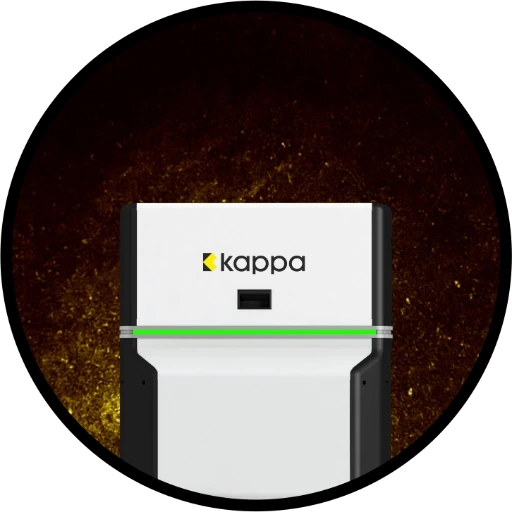
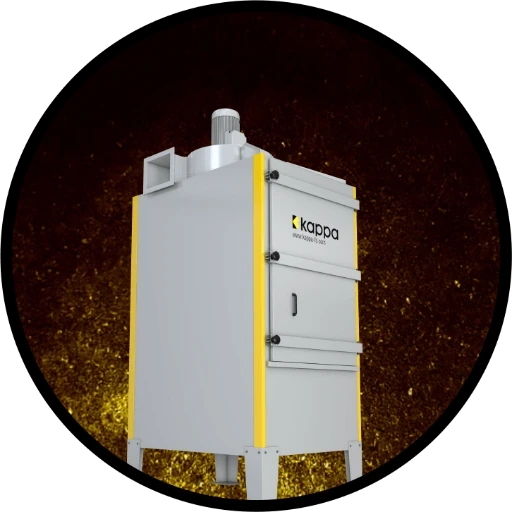
The Kappa Airdry oil and emulsion mist separatorrsupplies several machines up to the entire machine park through an oil-tight piping network – with typically 1,500 to over 20,000 m³/h. Based on the principle of selective separation, each filter stage specifically separates a droplet size until the finest aerosols are separated in the main stage. The filter stages are individually configurable, and a later change of the coolant lubricant is also possible.
Useful for:multiple machines, additional sources such as rework stations or chip containers, and high vapor loads.
The advantage:In exhaust operation, vapors, moisture, odors, and waste heat leave the hall instead of concentrating there.
Option 3: Hall Air Cleaning
Even good extraction systems leave diffuse residual emissions, for example during cleaning or manual work. The Kappa A.I.R. hall air cleaning system introduces fresh air at ground level without drafts. It creates a fresh air lake that displaces emissions and waste heat to the hall ceiling. There, they are captured, filtered, and the heat is recovered. A.I.R. thus takes care of ventilation, emission capture, as well as heating and cooling in one system.
Useful for:larger halls, visible deposits or odors in adjacent areas, and high heat input from production.

Practical example: Combination of all 3 options
In the 10,000 m² large machining hall Kappa has connected all three levels: One Airdry separator per machining line – a total of five – captures the direct coolant lubricant emissions. Diffuse emissions and waste heat push the draft-free fresh air to the ceiling, where Kappa systems clean 90,000 m³ of exhaust air per hour. The recovered heat conditions the supply air. According to the customer, this has reduced investment and ongoing energy costs.
What is economically viable
- Heat recovery:Process waste heat is used as heating energy for the fresh air instead of being discharged unused.
- Demand-oriented control:With Kappa Airdynamic the extraction performance adjusts to the actual machine operation.
- Less cleaning and downtime:Without an oil film, cleaning effort, slip hazards, and contamination of controls decrease.
- One system instead of several:Ventilation, extraction, and air conditioning from a single source reduce interfaces and investment needs.
Interesting facts
FAQ
The regulations are strict and vary by country. The return must not significantly increase the concentration of hazardous substances in the workplace. Since filters hardly retain vapors, Kappa recommends exhaust operation with heat recovery.
For individual, well-capsulated machines, often yes. With multiple machines, diffuse emissions usually remain in the hall. Additional hall ventilation and extraction are needed for that.
As soon as multiple machines or auxiliary sources such as chip containers need to be extracted. In exhaust operation, it additionally removes vapors, moisture, and waste heat from the hall.
Not if the waste heat is recovered. Kappa systems use the cleaned exhaust air to heat the fresh air.