Hall ventilation for the industry: planning, construction, and service
A good industrial ventilation system does not simply bring as much air as possible into the hall, but rather delivers the right air to the right place. To achieve this, it must be designed to meet the demands of production and coordinated with the extraction system. Kappa takes care of everything from the initial assessment through to manufacturing, installation and after-sales service – using its own staff since 1993.
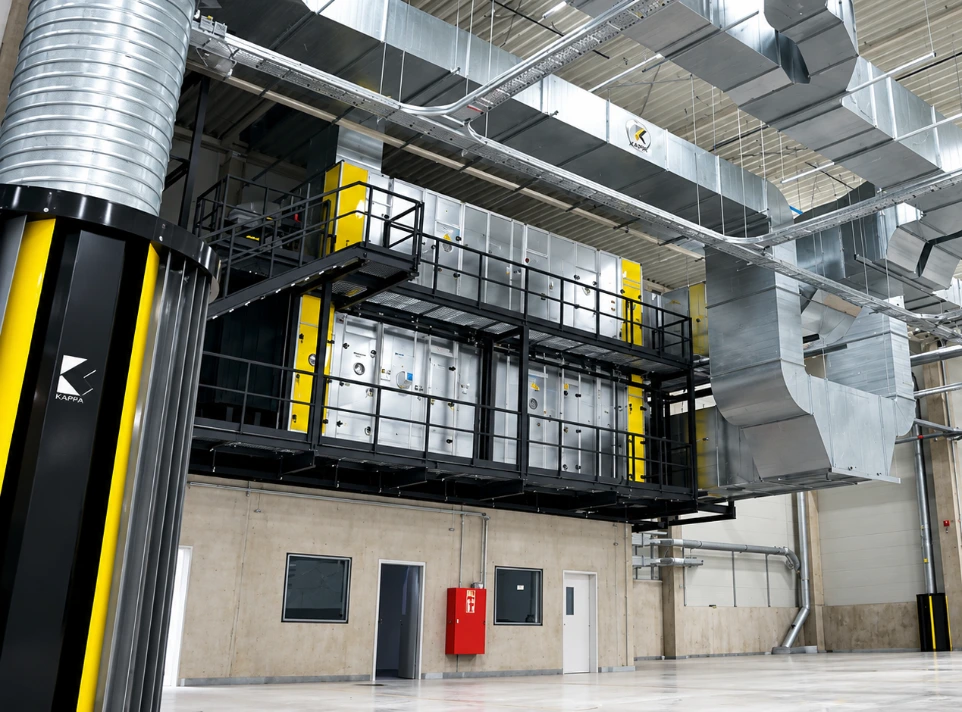
What does a hall ventilation system has to achieve in the industry?
A hall ventilation system must perform more in production, storage, and logistics halls than the ventilation of an office building. It removes heat, smoke, dust, vapors, and aerosols, replaces the contaminated hall air with filtered fresh air, and thus keeps temperature, air quality, and humidity stable. This protects employees, machines, and processes and ensures compliance with occupational safety regulations.
Modern systems significantly reduce heating and cooling costs through heat recovery. Depending on the hall, central ventilation systems or decentralized roof units are used, often combined with hall heating and cooling into a complete hall climate system. For plant management, production, and maintenance, three things ultimately matter: good conditions in the hall, a predictable energy demand, and a project that is completed on time and without unnecessary disruptions to production.
What to consider legally
In both countries, it applies: Considering the purpose of use, work processes, physical strain, and number of people, there must be sufficient health-friendly breathing air available. Mechanical ventilation becomes necessary at the latest when natural ventilation is insufficient, for example, in the presence of heat, smoke, vapors, or pollutants in the hall. Ventilation systems must function reliably and be regularly checked and maintained. Additional regulations apply to certain processes, such as those involving hazardous substances or explosion risks.
In Austria and Germany, the workplace regulations primarily specify the requirements that a hall ventilation system must meet:
- in Austria the AStV,
- in Germany the ArbStättV. In Germany, the technical rule ASR A3.6 "Ventilation" specifies these requirements. If an employer applies these rules, they can assume that they are complying with the requirements of the ArbStättV.
More air does not mean better air
Many halls are ventilated using mixed ventilation: The supply air flows in at high speed from above and dilutes the hall air. With high heat and emission loads, this airflow can carry smoke and pollutants back into the workspace. Increasing the air volume primarily raises electricity and heating energy demand, with little benefit to the workplaces.
Criteria for selecting the right hall ventilation
The right hall ventilation depends on the hall, the processes, and the operational requirements. Clarifying the following criteria early on helps avoid planning errors and unnecessary operating costs:
- Use of the hall:Production, storage, or logistics impose very different requirements on air distribution and air volume.
- Type of air pollution:Heat, dust, smoke, vapors, or aerosols each require appropriate collection and filtration concepts.
- Hall size and room height:They determine whether central systems or decentralized roof units are more suitable.
- Number of workplaces:This determines the legally required minimum amount of outside air.
- Employee protection and standards:The system must reliably meet the requirements of the workplace regulations in Austria and Germany.
- Energy efficiency/heat recovery:Demand-oriented control and utilized waste heat significantly reduce heating, cooling, and electricity costs.
- Used production materials:Coolants, combustible dusts, or hazardous materials influence filtration technology and explosion protection.
- Combination with heating and cooling:A coordinated hall climate system is usually more efficient than individual island solutions.
- Implementation in ongoing operations:Short assembly times and planned construction phases keep interventions in production low.
- Maintenance and Service:Easily accessible components and a reliable service partner ensure long-term efficient operation.
How extraction and ventilation work together
A suction system captures emissions directly at the source, such as at a welding station. The industrial ventilation supplies the entire hall with outside air and removes heat and residual emissions. Both are interconnected: every amount of air extracted must be replaced as supply air. Therefore, suction and hall ventilation should be planned together.
A clear sequence of steps, as set out in the German workplace regulation ASR A3.6, is more effective: first prevent emissions or extract them at source, and only then remove the residual loads via the hall ventilation system. Kappa plans in precisely this order – as a specialist in extraction and filter technology as well as in hall ventilation.
Heat recovery: use instead of discharge
In many production halls, machines and processes generate more heat than is needed for heating in winter. A hall air cleaning system with heat recovery utilizes this waste heat to preheat the fresh supply air instead of discharging it unused through the roof.
A clean exhaust air is a prerequisite: dust, smoke, and oil mist would otherwise quickly contaminate the heat exchangers and reduce their performance. Therefore, filtration and heat recovery should be part of a joint planning. If the exhaust air is cleaned well enough, it can additionally be returned entirely or partially as recirculated air into the hall. This reduces the amount of outside air that needs to be heated or cooled, lowering the energy demand of the hall.
How does Kappa design a ventilation system for industrial use?
The basis is the loads of your process. Kappa captures heat sources, emissions, workplaces, and operating times and derives air management, air volumes, filter technology, and control from this.
Supply air and exhaust air as one system
In the Kappa A.I.R.™ hall ventilation system, extraction and ventilation are combined in a single unit. Fresh air flows draught-free into the work area at floor level. Heat and emissions rise upwards, where they are captured and filtered beneath the hall ceiling. Some of the purified air can be recirculated into the hall, whilst the waste heat is used to preheat the supply air. If required, the system can also provide heating and cooling. According to Kappa, compared with separate individual solutions, this reduces investment costs by up to 30 per cent and operating costs by up to 50 per cent.
Performance as needed
Variable speed fans adjust the air volume to the current production state. If only part of the lines are running, power consumption decreases significantly. How much this saves depends on the load profile and operating hours.
Customer projects
References
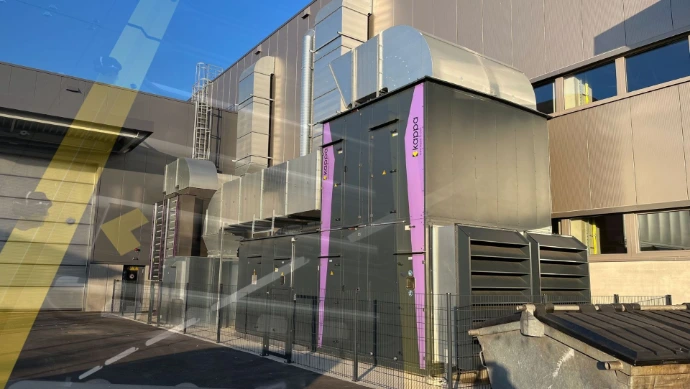
Industrial air purification and heat recovery at a machinery and plant manufacturer
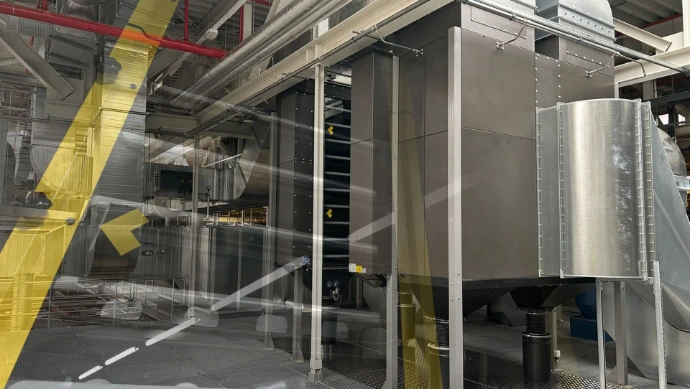
Hall air purification for robotic and manual welding workplaces
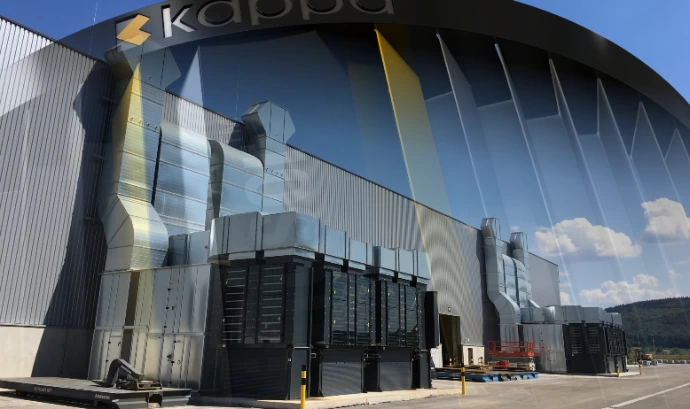
Energy-efficient exhaust, indoor air, and energy technology
>> to the project
How does a ventilation project with Kappa proceed?
From analysis to service, the project is in one hand. Interfaces to construction, electrical, and building technology are defined before the start of construction. A dedicated project manager accompanies you through all phases.
1. On-site inventory: Hall plan, process flow, heat and emission sources, production times, crane tracks, and possible routing.
2. Concept and feasibility: System variants with investment and operating costs as a decision-making basis.
3. Planning and manufacturing: Schedule and assembly plan tailored to your production operation; components from our own manufacturing.
4. Assembly and commissioning: by our own assembly personnel, including adjustment, measurement, and documented handover.
5. Operation and service: Maintenance, energy inspection, and digital condition monitoring upon request.
Existing system: modernize instead of replace?
In some cases, it is worth modernising and retrofitting industrial ventilation systems with digital technology. An energy audit will reveal whether the system’s design, control system and fans still meet current requirements, and will provide an action plan setting out potential savings and the payback period.
With Kappa digital RetroFIT™, existing systems can also be monitored digitally without interfering with the system control or the IT infrastructure.
Facts at a glance:
- An industrial ventilation system is designed according to heat and emission loads not according to hall size.
- More air does not mean better air: What matters is how the air is managed.
- Emissions should be captured at the source while the hall ventilation takes care of the residual loads.
- Over the lifespan, about three quarters of the costs are attributed to operation – energy and maintenance are decisive.
- Kappa is responsible for planning, manufacturing, assembly, and service itself; certified according to ISO 9001 and ISO 45001.
Interesting facts
FAQ
In Austria, the Workplace Regulation (AStV § 27) requires at least 35, 50, or 70 m³ of outside air per person per hour for mechanically ventilated rooms, depending on physical workload. In Germany, the ASR A3.6 regulates the requirements. In production halls, however, heat and emissions usually determine the necessary amount of air, not the number of people.
For halls with welding, casting, or forming, a low-level supply air system is usually suitable, where heat and emissions rise and are extracted under the ceiling. A classic mixed ventilation system can, however, carry pollutants back into the work area. The appropriate solution is shown by the inventory.
For new ventilation units with supply and exhaust air in non-residential buildings, the EU Ecodesign Regulation (EU) No. 1253/2014 generally mandates heat recovery; there are exceptions for special applications. In halls with significant process heat, it often pays off regardless.
Not necessarily. Kappa plans the assembly process together with your production and divides the work into construction phases that, whenever possible, coincide with planned stoppages. Which areas will be closed and for how long will be determined before the order is awarded.
A reliable figure can only be provided after the inventory assessment. The costs depend on the process, hall size, filter technology, and heat recovery. More important than the purchase price are the life cycle costs, as energy and maintenance account for about three-quarters over the usage period. Therefore, Kappa compares options with investment and operating costs.
In some cases, yes. An energy inspection shows where energy is being lost and provides an action plan with potential savings and payback time. If a new building is more economical, the comparison of options will show that as well.
Sources
- Austria – AStV § 27 Mechanical Ventilation (JUSLINE):https://www.jusline.at/gesetz/astv/paragraf/27.pdf
- Austria – AStV § 27 (Forum Media, full text):https://www.forum-media.at/arbeitssicherheit/Vorschriften/Arbeitsstaettenverordnung/3.-Abschnitt/27.-Mechanische-Be-und-Entlueftung
- Germany – Workplace Ordinance ArbStättV (gesetze-im-internet.de):https://www.gesetze-im-internet.de/%61rbst_ttv_2004/BJNR217910004.html
- Germany – ASR A3.6 "Ventilation" (BAuA):https://www.baua.de/DE/Angebote/Regelwerk/ASR/ASR-A3-6
- Germany – Explanation ASR A3.6 (Forum Verlag):https://forum-verlag.com/blog-as/asr-a3-6
- DGUV/VBG Information on Ventilation in Workplaces:https://cdn.vbg.de/media/b1a38bb2eadd4c5cb2bdfe7c27afad8b/dld:attachment/215-550%20VBG%20Web.pdf