Hall air purification for industry: planning, construction, and service
An effective hall air purification system does not filter as much air as possible, but rather keeps emissions out of the breathing zone of employees. For this, it must be coordinated with extraction and hall ventilation. Kappa takes care of this from the initial assessment to the service – since 1993 with its own personnel.
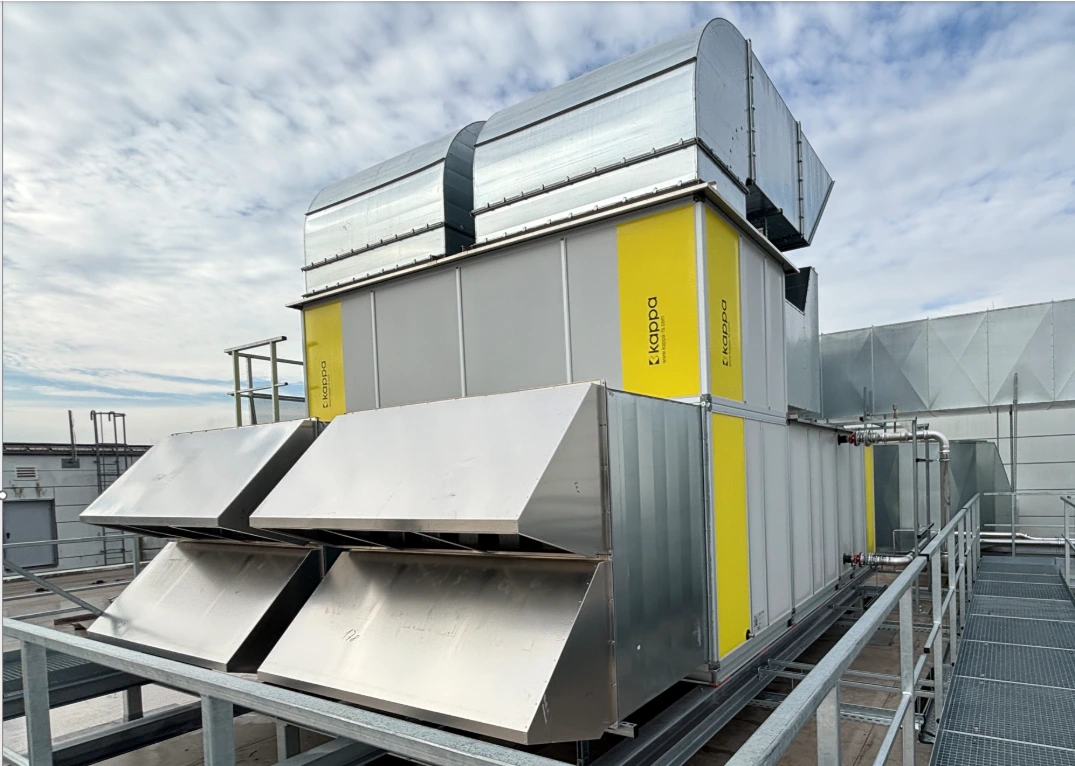
What is hall air purification?
Indoor air purification removes dust, fine particulates, smoke, oil mist and aerosols from the air in production halls. It complements extraction at source: anything not captured there – for example, in the case of changing workstations, large components or machinery that cannot be enclosed – is dispersed as residual emissions throughout the hall, rises as the temperature increases, and sinks back into the work area as it cools.
The system captures these residual emissions, filters them out and discharges the air into the open air or – where permitted – recirculates it back into the hall. This protects staff, reduces deposits on machinery and products, and lowers energy consumption.
Typical pollutants arewelding smoke, grinding and fine dust,oil and emulsion mistfrom machining as well as release agents and vapors from foundries. The type of substance determines the filter technology and the permissibility of recirculation.
What to consider legally
At the workplace, sufficient health-friendly breathing air must be available; ventilation and extraction systems must function reliably and be regularly checked. The central question for hall air purification is: Is it permissible to return cleaned air to the hall?
- Austria: The AStV (§ 27) regulates when workspaces must be mechanically ventilated, for example in the presence of smoke, vapors, or hazardous substances. The limit values regulation (GKV 2025 § 15) specifies when air may be returned when using carcinogenic work materials: generally a ban on recirculation, with narrowly defined exceptions for suspended particles.
- Germany: ArbStättV and ASR A3.6 regulate the ventilation of workplaces. For carcinogenic, mutagenic, or fertility-threatening dusts, TRGS 560 specifies the air recirculation: only with recognized methods or devices, usually with a separation efficiency of over 99.995% (e.g., dust class H).
Which requirements apply in individual cases depends on materials and processes. Kappa checks this in the concept and documents the separation performance during commissioning.
Air management decides: layer ventilation instead of mixed flow.
The most effective hall air cleaning starts at the source: emissions should first be avoided or directly extracted, only then the remaining loads should be removed from the hall..
Many recirculation units blow filtered air at high speed.
This mixed flow dilutes
the hall air, but can carry contaminated air from the roof area back to the workplaces under high thermal loads. In layer ventilation (also known as source ventilation), clean air flows in a low-impulse manner near the floor. Heat and emissions rise upwards and are captured under the ceiling; the area below remains clean. Thus, a significantly lower air volume is sufficient for the same effect.
In very high halls, rising air can cool down and sink again. Therefore, capture height, extraction points, and supply air management must be coordinated with room height and thermals – this clarifies the design.
What systems are available for hall air purification?
System |
Funktionsprinzip |
Geeignet für |
|---|---|---|
Hallenluftfilter Kappa Puron® DX |
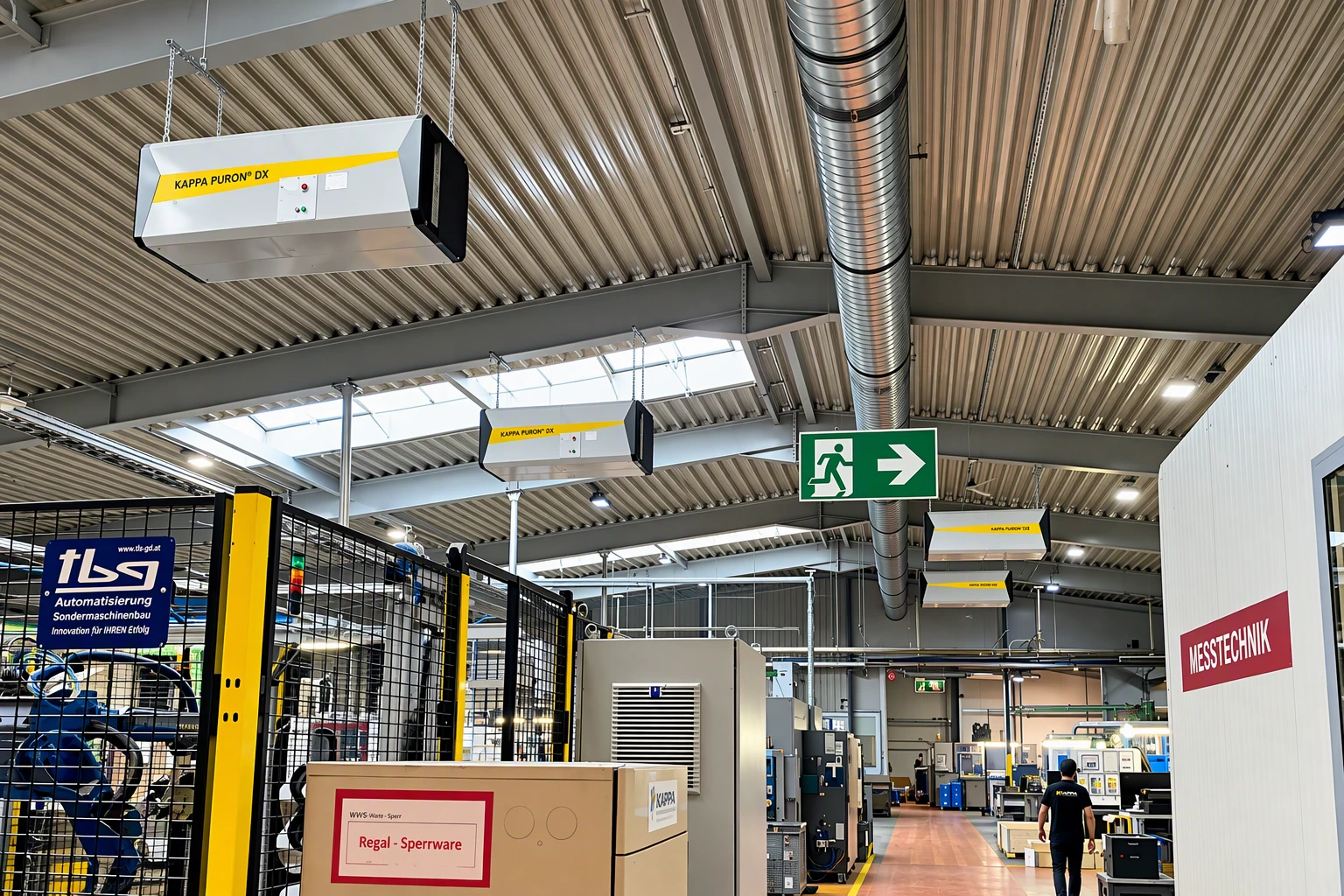
Plug-and-play recirculation units under the hall ceiling filter dust, fine dust, smoke, and aerosols. Available in a rental model. |
Existing halls, quick improvement without renovation, specific areas, logistics, recycling. |
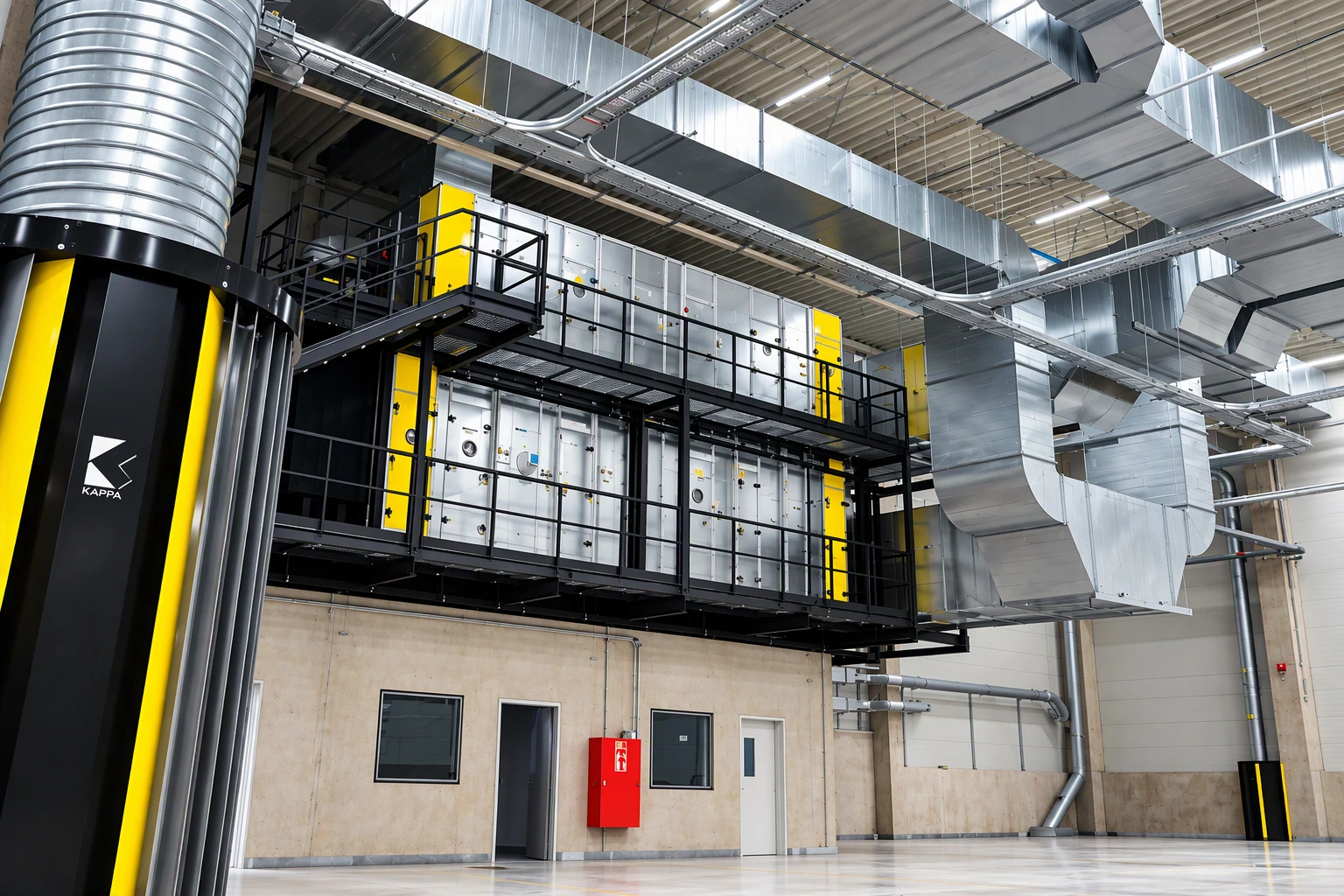
Hallenluftsystem Kappa A.I.R.™ | Layer ventilation: exhaust and room air technology in one system, with filtration, heat recovery, optional heating and cooling. | Halls with high heat and emission loads, new construction, comprehensive modernization. |
Zentrale Kappa MTA™ | Central exhaust air purification and air treatment with energy recovery for multiple areas. | Large production areas, many emission sources, high energy demand. |
Criteria for selection
- Emissions and materials: determine filter technology and whether air can be recirculated.
- Proportion of source extraction: The more captured at the source, the smaller the hall air purification.
- Heat loads and room height: determine how emissions are distributed and where they are captured.
- Hall layout: Crane tracks, machine locations, and traffic routes determine equipment and air outlet locations.
- Interaction with ventilation, heating, and cooling: A coordinated hall climate system is more efficient than island solutions.
- Implementation during ongoing operations: Decentralized units can often be retrofitted without downtime.
What hall air purification costs
– and where it
is cost-effective.
In air handling systems, about three-quarters of the total costs are attributed to operation, while only one-quarter is for investment. The largest expense is usually not the filters, but the air that goes outside and needs to be heated or cooled as outside air.
Kostenposten |
Treiber |
Hebel |
|---|---|---|
Heating and cooling of supply air |
Air volume, outside air proportion, season |
Layer ventilation, recirculation operation, heat recovery |
Electricity for fans | Air volume, pressure loss, operating hours | Design according to load, demand-oriented control |
Filters and maintenance | Material type, filter loading, cleaning | Appropriate filter area, cleaning as needed, fixed service |
Follow-up costs in production | Deposits on machines, products, hall structure | Recording of residual emissions, monitoring of air quality |
Recirculation in winter, exhaust air in summer
Where recirculation is permitted, the purified, warm air remains inside the hall in winter; in summer, it is discharged either wholly or partly to the outside to prevent the hall from overheating. Where air must not be recirculated, a heat recovery system preheats the supply air using the waste heat. In both cases, the exhaust air must be clean; otherwise, the heat exchangers will become contaminated.
How does Kappa plan a hall air cleaning?
The design follows the actual heat and material loads according to VDI 3802, not a flat air exchange rate. Kappa identifies emission sources, materials, heat sources, workplaces, and operating times and derives air flow, air volumes, filter technology, and control from this.
Kappa A.I.R.™: Fresh air flows freely into the workspace through floor diffusers and wedges itself under emissions and waste heat. These are captured and filtered under the ceiling, and the waste heat preheats the supply air. Compared to individual solutions, this reduces investment costs by up to 30% and operating costs by up to 50%, according to Kappa project experience.
Kappa Puron® DX: improves the air in existing halls without interfering with the ventilation – ready to connect, quiet, also available in a rental model including maintenance.
Control and Monitoring: Kappa Airdynamic™ adjusts the air volume to the current emission load, Kappa Airic makes air quality measurable.
Where hall air purification reaches its limits
Hall air purification does not replace source extraction:
- Where concentrations are high directly at the workplace – for example, in a welder’s breathing zone – local exhaust ventilation or protective equipment is also required.
Not every medium is suitable for recirculation operation, and in the case of flammable or explosive dusts, there are additional requirements regarding explosion protection.
What a solution achieves is only shown by the design for the specific hall.
This is how a project with Kappa proceeds
1. On-site assessment: emission sources, materials, heat loads, existing systems; including measurements if required.
2. Concept and cost-effectiveness: Options with capital and running costs, including an assessment of the permissible air recirculation.
3. Planning and manufacture: An assembly plan tailored to your production; components manufactured in-house.
4. Installation and commissioning: carried out by our own staff, including calibration, measurement and a documented handover.
5. Operation and servicing: maintenance, energy efficiency inspection, and digital condition monitoring on request.
Existing systems can sometimes be modernized instead of replaced:
The energy inspection shows savings potential and payback time, Kappa digital RetroFIT™ makes existing systems digitally monitorable.
Facts at a glance
■ Indoor air purification is designed on the basis of emission and heat loads (VDI 3802), not on the basis of the size of the hall.
■ Capture emissions at source first, then remove any residual emissions from the hall.
■ layer ventilation keeps the work area cleaner with less air than a mixed flow.
■ Whether air may be recirculated depends on the materials used (AT: GKV 2025 § 15, DE: TRGS 560).
■ Around three-quarters of the costs are attributable to running costs – energy and maintenance are the key factors.
Interesting facts
FAQ
A hall ventilation exchanges contaminated air for outside air. Hall air purification filters dust, smoke, and aerosols from the hall air so that it can be cleaned and discharged or returned. In production halls, both complement each other; Kappa A.I.R.™ connects them in one system.
No. Where emissions can be captured at the source, it is usually more effective and cheaper. The hall air purification takes care of the residual emissions that cannot be captured there.
For individual areas or as an immediate measure, a recirculation unit can help. In cases of high emissions and heat loads, hall air filters mounted on the ceiling or a hall air system with stratified ventilation are more effective. Kappa Puron® DX hall air filters are available in a rental model.
That depends on the substances. Strict regulations apply to carcinogenic substances: in Austria, the GKV 2025 § 15, in Germany, the GefStoffV with the TRGS 560. For many other emissions, recirculation with suitable filter technology is possible.
Yes, if cleaned air is allowed to remain in the hall or its heat is recovered, and the system is regulated according to demand. The amount of savings depends on air volumes, operating times, and climate and is calculated in a variant comparison.
A reliable figure is only available after the inventory assessment. Lifecycle costs are crucial because energy and maintenance account for about three-quarters. Therefore, Kappa compares variants with investment and operating costs.
Sources
- Austria – AStV § 27 (gesetzefinden.at):https://gesetzefinden.at/bundesrecht/verordnungen/b-astv/para-27
- Austria – GKV 2025 § 15 Luftrückführung: https://www.forum-media.at/evaluierung/inhalt/-15.-Luftrueckfuehrung/525730
- Germany – ASR A3.6 "Ventilation" (BAuA):https://www.baua.de/DE/Angebote/Regelwerk/ASR/ASR-A3-6
- Germany – TRGS 560 (BGN):https://vorschriften.bgn-branchenwissen.de/daten/tr/trgs560/titel.htm
- KomNet – Separation efficiency in air recirculation:https://www.komnet.nrw.de/_sitetools/dialog/44165