Dust extraction systems for industry: capturing dust, separating fine dust, saving energy
Kappa captures dust and fine dust where it is generated, separates it energy-efficiently, and plans piping, air guidance, and heat recovery at the same time. From the compact filter at the workplace to the dust extraction building: planning, manufacturing, assembly, and service from a single source.
Briefly explained: What is a dust extraction system?
A dust extraction system sucks in dust-laden air at the source, separates the particles in a filter from the airflow, and releases the cleaned air outside or returns it to the hall. It consists of capture elements, piping network, filter system with cleaning and dust discharge, as well as fan and control.
Facts at a glance
- Separation performance, energy requirements, and operating costs depend on particle size, dust quantity, dust properties, and air volume – not just on the chosen filter.
- The fan is usually the largest energy consumer of a dust extraction system. Any unnecessary pressure loss in the piping network and filter costs power during continuous operation.
- In Germany, according to TRGS 900, a general dust limit value of 1.25 mg/m³ for alveolar dust (A-dust) and 10 mg/m³ for inhalable dust (E-dust). Substance-specific limit values take precedence.
- Kappa Mykron® removes particles smaller than 0.4 µm around 30 per cent more effectively than a conventional cartridge filter and reduces energy consumption by up to 35 per cent.
- Compared with an 8-metre-long bag filter, Kappa Ekon® requires half the floor space, halves the residual dust content and reduces energy consumption by a third.
- Combustible dusts require a comprehensive explosion protection concept according to ATEX – from the capture to the dust discharge.
Which dust, which requirement?
Dust is not equal to dust. For the design of the dust extraction, particle size and properties matter more than the quantity alone.
|
Typical sources |
What this means for the dust extraction |
|
|---|---|---|---|
Coarse dust |
Grinding, blasting, breaking, bulk handling |
Pre-separation, abrasion-resistant design, sufficient transport speed in the pipe network |
|
Fine dust (alveolar) | Grinding, polishing, mineral and construction material processing, thermal processes | Filter elements with surface filtration; the clean gas values determine whether recirculation is possible | |
Smoke and ultrafine particles | Welding, plasma and laser cutting, melting processes | Particles in the submicron range; high requirements for filter medium and cleaning | |
Combustible dusts | e.g. aluminum, magnesium, wood, plastics, organic dusts | ATEX concept incorporating measures such as pressure relief, decoupling or spark detection – depending on the type of dust and the plant |
Which filter technology is suitable for your process?
Kappa develops and manufactures dust extraction systems for air volumes from a few thousand to over 500,000 m³/h. The suitable design depends on dust, air volume, space availability, and energy goals.
|
|
Kappa solution |
||
|---|---|---|---|---|
Compact and mobile filters |
Individual workstations, changing locations, smaller air volumes |
|||
Fine dust filter (cartridge design) | Fine dust and smoke, direct capture and process exhaust air, small to very large air volumes | Kappa Mykron® with Kappa Sequence Dedusting® and Nano+ filter elements | ||
Bag filter | High dust loads, coarse and fine dust | Kappa Plenon® with integrated pre-separation up to 50 µm | ||
Large dust extractor | Large systems with limited space and high energy costs; alternative to bag filters | Kappa Ekon® with pre-separation chamber in every filter tower | ||
Dust removal building | Large dust removal with requirements for noise and emission protection | Kappa Zeron® – dust- and soundproof industrial building |





Kappa Mykron®: fine dust filter with energy-saving factor
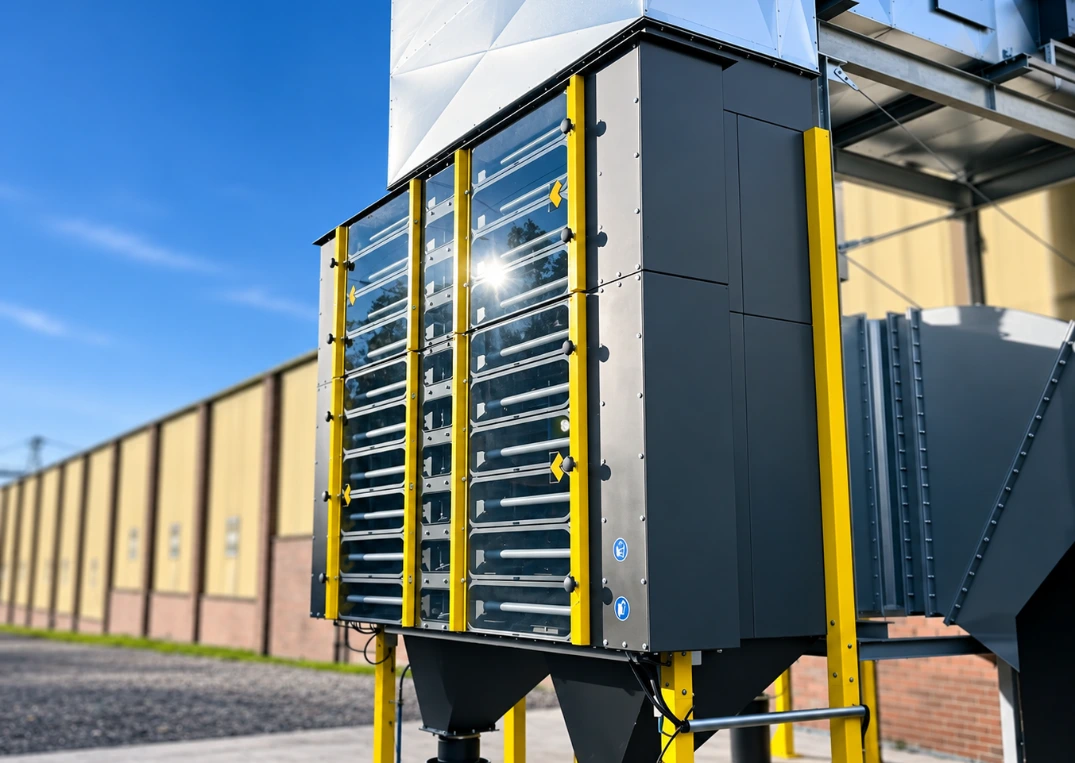
The patented Kappa Sequence Dedusting® interrupts the flow of a filter element during and immediately after cleaning. The dislodged dust falls into the hopper instead of being immediately drawn back to the element. Together with the Kappa Nano+ filter elements, the system resistance remains low – and thus the energy requirement of the fan. The clean gas area is fully visible through maintenance doors made of safety glass.
> Learn more about Kappa Mykron®
Kappa Ekon®: when bag filters reach their limits
Kappa Ekon® combines coarse and fine dust separation in a compact system and integrates raw gas distribution and clean gas area into the system concept. The modules are prefabricated in the factory and assembled on-site. In realized projects, Ekon® achieved clean gas values significantly below 0.5 mg/m³.¹
> Learn more about Kappa Ekon®
Where are Kappa dust extraction systems used?
Kappa dust extraction systems operate wherever industrial processes release dust, fine dust, or smoke.
- In metal processing, they capture and filter grinding, polishing, and blasting dust as well as welding smoke and particles from plasma and laser cutting – from individual workstations to complete production lines.
- In foundries, they extract dust from sand preparation, discharge stations, cleaning, and melting operations, where high dust loads, abrasive particles, and large air volumes meet.
- In plastic production, they separate dust from grinding, milling, deburring, and handling granules and powders; since many plastic dusts are flammable, Kappa incorporates explosion protection according to ATEX from the very beginning.
During grinding and surface treatment, particularly fine, alveolar particles are generated. Here, Kappa Mykron®, Ekon®, and Plenon® ensure low clean gas values – the prerequisite for returning the cleaned air to the hall and saving heating energy.
What limit values apply for dust?
For the dust extraction, two types of limit values are relevant:
- At the workplace (hall air): In Germany, the TRGS 900 sets the general dust limit value – 1.25 mg/m³ for A-dust and 10 mg/m³ for E-dust. In Austria, the limit values regulation (GKV) governs the permissible concentrations. For dusts with specific effects, such as quartz, hardwood, or metal dusts, there are separate, usually significantly stricter values.
- At the chimney (emission): In Germany, the TA Luft sets the emission limits while in Austria, the plant-specific regulations and the respective approval notice do.
Kappa designs dust extraction systems so that the limits are not barely met, but are complied with reserves – so that a later tightening or production expansion does not require a new system.
How does a dust extraction system work?
Every dust extraction system operates in five steps. How well the system works and how much energy it requires is determined in each individual step.
- Capture: Extraction hoods,
Extraction booths,
Extraction arms
or machine enclosures capture the dust at the source. The closer to the
point of origin, the smaller the required air volume – and thus the entire
system.
- Transport in the pipe network: The
flow velocity must be high enough that no dust settles in the
pipes, but not higher than necessary. Shut-off valves deactivate unused
extraction points.
- Pre-separation: Coarse particles are
separated before they reach the filter elements. This relieves the
elements and extends their service life.
- Filtration and cleaning: Fine dust is
retained on the surface of the filter elements. A pulse cleaning
regularly dislodges the dust cake to keep the pressure drop low.
- Discharge and clean air: The separated dust falls into hoppers and is discharged. The cleaned air goes outside, back into the hall, or through heat recovery.
Workplace filters, central dust removal or hall air cleaning?
All three concepts have their justification, and they can be combined. Kappa plans all three and recommends the solution that fits the process, hall layout, and operating times.
- Workplace and individual filters: Each emission source receives its own
filter. The concept is suitable for individual workstations, small air volumes
and decentralized structures. The cleaned air is usually returned to the hall.
- Central
Dust Extraction: Multiple machines or an entire line are connected via a piping network
to a common filter system. Maintenance and dust removal
are concentrated in one place, the exhaust air can be directed outside and its
heat recovered.
- Hall Air Cleaning Kappa A.I.R.™: It captures diffuse emissions, that are not completely extracted at the source – for example, during the handling of workpieces or when opening enclosures. At the same time, the air system can be used for heating, cooling, and heat recovery.
Dust extraction of combustible dusts: Explosion protection from the start
Many industrial dusts are combustible and can create explosive atmospheres in the filter system. Kappa plans explosion protection as part of the system concept: zoning, explosion-proof design of the filter system, pressure relief or suppression, decoupling of pipelines, as well as spark detection and extinguishing.
From concept to service: this is how Kappa implements your dust extraction system
Kappa is responsible for the entire project with its own personnel. A dedicated contact person accompanies you through all phases.
1. On-site analysis: Processes, types of dust, emission sources, hall situation, and existing systems; if desired, with measurement of air quality and flow conditions.
2. Dust extraction concept: Collection, air volumes, piping network, filter technology, explosion protection, exhaust or recirculation operation – with investment and operating costs in comparison.
3. Manufacturing: Filter system and components from in-house production in Steyr, modular and ready for connection.
4. Installation and commissioning: by in-house installation personnel, tailored to your production operation, with adjustment and documented handover.
5. Service: Maintenance, filter change, energy inspection and upon request digital condition monitoring with Kappa digital RetroFIT™.
Let's talk about your project
Share your requirements and goals with us. Our specialists are happy to support you from the first consultation to implementation.
Kappa Filter Systems GmbH
AT-4973 Steyr-Gleink, Im Stadtgut A1
0043 7252 21 111
DE-40549 Düsseldorf, Wiesenstraße 21
0049 211 506 6978 0
office@kappa-fs.com
www.kappa-fs.com
Interesting facts
FAQ
That depends on air volume, type of dust, explosion protection, and design – from the mobile workplace filter to large-scale dust extraction, there are orders of magnitude in between. For cost-effectiveness, operating costs over the lifespan are just as critical as the investment. Therefore, Kappa compares both in the dust extraction concept.
Hose filters are suitable for high dust loads and large air volumes, cartridge filters for fine dust and smoke in a compact design. Kappa Ekon® combines the advantages of both types and requires only half the area compared to a hose filter.
The size is determined by the air volume, which comes from the capture: The closer and more targeted the dust is captured at the source, the less air needs to be moved and filtered. Therefore, every Kappa planning starts at the emission sources, not at the filter.
That depends on the type of dust, the amount of dust, and operating times. Effective cleaning and pre-separation significantly extend the service life. A differential pressure monitoring shows when a change is actually necessary.
Common causes are clogged filter elements, declining cleaning efficiency, open extraction points on machines that are not running, or deposits in the piping network. An energy inspection shows where energy is being lost.
Yes, if the clean gas values are reliably maintained and the limits at the workplace are not endangered. For health-hazardous, such as carcinogenic dusts, especially strict requirements apply; in this case, exhaust air to the outside with heat recovery is often the better solution.
Flammable Dusts can create explosive atmospheres in filter systems and piping networks. An explosion protection concept according to ATEX is necessary, such as with pressure relief, decoupling, and spark detection. Kappa plans these measures from the very beginning.
In Germany, a general dust limit value of 1.25 mg/m³ for A-dust and 10 mg/m³ for E-dust applies according to TRGS 900. In Austria, the limit values regulation (GKV) governs the permissible values. For certain dusts, substance-specific, stricter limit values apply.
Often yes. The modular Kappa systems Mykron® and Ekon® can be supplemented with additional modules. For existing systems, an inventory shows whether the fan, piping network, and filter area can accommodate the additional air volume.