Heat recovery in industry: Utilizing waste heat –
even if the exhaust
is contaminated
The extraction system discharges thousands of cubic meters of warm air outdoors every hour, while the heating system has to bring cold fresh air back to temperature. You pay for the same heat twice. Heat recovery retrieves this heat.
With over 30 years of experience in industrial extraction and filtration technology, we clean your exhaust air so that its heat can be used permanently.
What does heat recovery in industry mean?
Waste heat is generated in almost every production process – in machining centers, during welding, in furnaces, dryers, and compressors. There are two approaches for its use:
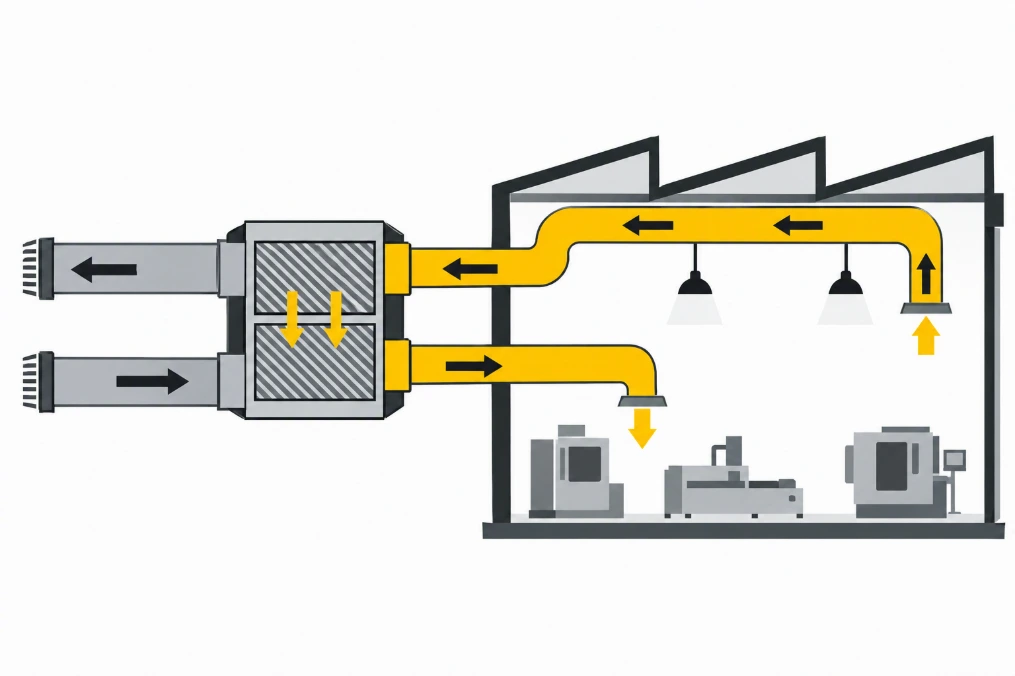
- Heat recovery in the strict sense: the heat from the extract air is transferred to the supply air within the same ventilation system (definition according to VDI 2071).
- Waste heat recovery: Heat from industrial processes is transferred to other users – such as for heating factory buildings or washing facilities – or raised to a higher temperature level via a heat pump. In summer, waste heat can even be used to generate cooling via adsorption chillers.
Where does usable waste heat arise in your operation?
- Hall ceiling: Through temperature stratification, warm air collects under the roof, where it benefits no one.
- Machining and processing centers: warm exhaust air with oil and emulsion mist from cooling lubricants.
- Welding, cutting, grinding: large volumes of extraction air with smoke and fine dust.
- Furnaces, hardening shops, painting and drying systems: Process exhaust air with high temperatures – usable with Kappa MTA™ up to 140 °C.
- Compressed air compressors: About 90% of the electric energy used is converted to heat.
- Cooling systems and chillers: Condenser heat, which is often released unused through the roof.
Which technology Kappa uses for heat recovery
Which
method brings the most in your hall depends on three factors: where supply-
and exhaust air ducts run, how heavily the exhaust air is loaded, and what
temperature level it has. Therefore, Kappa does not rely on a standard device,
but selects the technology accordingly – and always switches on the filtration
beforehand.
- Plate heat exchangers
conduct exhaust air and fresh air through separate channels made of thin plates. The
heat transfers through the plate wall, and the air streams do not mix.
Without moving parts, they are robust and low-maintenance – ideal when supply and exhaust
can be routed side by side.
- Rotary heat exchangers
work with a slowly rotating storage mass that heats up in the exhaust air stream
and transfers the heat to the fresh air. They achieve very high
recovery rates but require clean exhaust air. In Kappa A.I.R.™, they are therefore used
behind a multi-stage filtration.
- Circulation connection systems
connect two separate heat exchangers via a water-glycol circuit. Supply-
and exhaust air do not need to be next to each other and never come into
contact. This makes them the first choice for retrofitting and widely
separated system components.
- Heat pumps
are used where the waste heat is too cold for direct use.
They raise the temperature to a usable level, such as for heating or
hot water.
- Hot
process exhaust air uses Kappa directly
or indirectly through the WRG module in the Kappa MTA™ – at temperatures up to 140 °C.
Economic efficiency and funding
The speed at which
heat recovery pays off is primarily determined by air volume,
hours of operation during the heating period, temperature level of the exhaust air, and
energy price. Multi-shift operation and warm process exhaust air significantly shorten the
payback period.
- Austria: Environmental funding domestically (UFI) through
the KPC, including "Heat recovery in refrigeration and ventilation systems".
- Germany: Federal funding for energy and
resource efficiency in the economy (EEW) through BAFA or KfW – systems for
heat recovery are eligible for funding.
Important: Funding applications are generally to be submitted before the award of the contract. The programs are continuously adjusted – Kappa supports you in preparing the technical documents.
Self-check: Is heat recovery worth it in your hall?
The more questions
you answer with yes, the greater your potential:
- Do you extract several thousand cubic meters of air per hour?
- Do you produce during the heating period in single or
multi-shift operation?
- Is the exhaust air contaminated with oil or emulsion mist, smoke, or
dust?
- Are there ovens, dryers, compressors, or refrigeration systems
with unused waste heat?
- Is your extraction or ventilation system older than ten
years?
Three or more yes? Then it’s worth taking a closer look.
The underestimated problem: heat recovery from contaminated exhaust air
Standard ventilation units
are designed for office or hall air. Industrial process exhaust air, on the other hand, contains
oil mist, emulsion aerosols, release agents, welding smoke, and fine dust.
If these substances enter the heat exchanger unfiltered, the following happens:
1. Deposits insulate the exchanger surfaces – the heat recovery rate decreases.
2. The pressure loss increases – fans require more power, part of the savings is lost.
3. Oil-containing deposits increase the fire load in the system. in der Anlage.
4.
Maintenance and cleaning become more frequent and
expensive.
Therefore, there is a fixed sequence in industrial air technology: first filter, then recover heat. Only emission-free air can be made available to people again or efficiently passed through a heat exchanger.
This is how Kappa implements heat recovery in 4 steps
1. Capture emissions
Extraction directly at the source or throughout the hall: With Kappa A.I.R.™ fresh air is introduced into the work area via Kappa Diffusor™, diffuse emissions are displaced to the hall ceiling and extracted there.
2. Filter exhaust air
Multistage, adapted filtration for emissions – for example Kappa Mykron® for dust and fine dust or Kappa Airdry™ for oil and emulsion mist. Result in the reference project: residual dust content below 0.1 mg/m³.
3. Recover heat
In the exhaust air cleaning and air treatment center Kappa MTA™ the heat recovery module is located behind the filter stages. Depending on the application, units with direct heat transfer for low temperatures up to 60 °C or with direct or indirect transfer for medium temperatures up to 140 °C are used. Optionally, compressed air flushing and high-pressure water nozzles automatically clean the exchanger. An MTA™ unit processes 35,000 to over 125,000 m³/h.
4. Use heat as needed
The recovered heat tempers the fresh air, heats the hall, or is supplied to processes. Kontherm® distributes heat and cold precisely in the work area. Kappa Airdynamic and Kappa Zeromatic® automatically adjust the air volume to the production load – because the cheapest kilowatt hour is the one that doesn't need to be moved at all. Geothermal energy, solar energy, and conventional heat generators can be integrated.
Interesting facts
FAQ
Heat recovery
transfers heat within a ventilation system from the exhaust air to
the supply air. Waste heat utilization transfers process heat to other consumers, such as
the hall heating or via a heat pump to processes.
Depending on the system, typically 50 to 80 % of the heat from the exhaust air is recovered. In recirculation operation with hall air cleaning, the heat remains completely in the hall.
Yes, if the exhaust air is effectively filtered before the heat exchanger. Kappa MTA™ combines filter stages and HRV module in one system, optionally with automatic exchanger cleaning.
In many cases yes. With Kappa MTA™, no additional structural measures are usually necessary for heating and cooling.
For non-residential ventilation units yes: The EU Ecodesign Regulation 1253/2014 requires a heat recovery system with a minimum thermal efficiency of typically 73 %.
Yes. HRV systems recover cold from conditioned exhaust air in summer. Additionally, waste heat can be converted into cold via adsorption chillers or the hall can be cooled using cooler outside air through free cooling.
In Austria through domestic environmental funding (KPC), in Germany through the federal funding EEW (BAFA/KfW). Applications are usually to be submitted before the contract award.
This depends on air volume, operating hours, waste heat temperature, and energy price. The higher the air volume and layer count, the shorter the payback period. A reliable figure is provided by the potential analysis.
Let's talk about your project
Please share your requirements and goals with us. Our specialists are happy to support you from the initial consultation to implementation.
Kappa Filter Systems GmbH
AT-4973 Steyr-Gleink, Im Stadtgut A1
0043 7252 21 111
DE-40549 Düsseldorf, Wiesenstraße 21
0049 211 506 6978 0
office@kappa-fs.com
www.kappa-fs.com